HODL is crypto slang for holding. In this comparison, HODL means keeping the same starting tokens without providing liquidity.
The question is simple: What would these same starting assets be worth if I had kept them instead of providing liquidity?
What does LP vs HODL mean?
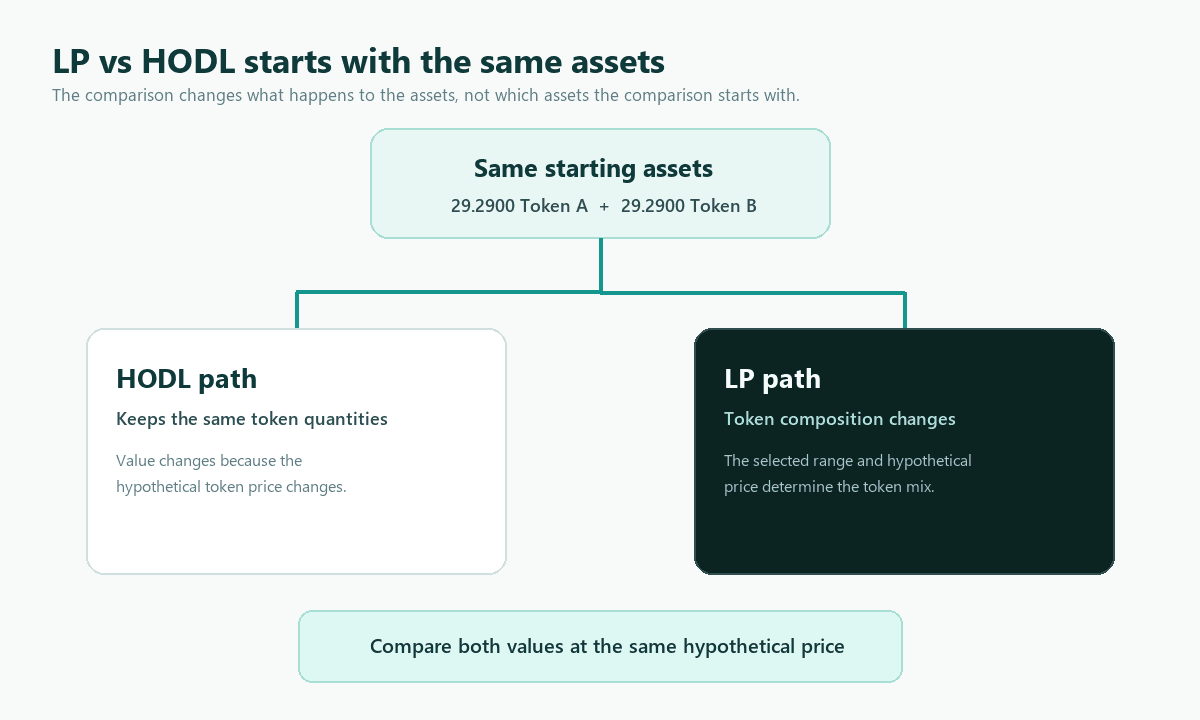
The LP path and the HODL path begin with the same assets. The HODL path keeps those token quantities unchanged. The LP path places them into a concentrated-liquidity position whose token composition changes as price moves through the selected range.
SmoothLP values both paths at the same hypothetical price and in the displayed quote token. The result is labeled LP vs HODL before fees because future swap fees are excluded unless you model them separately.
Why does an LP position change as price moves?
Concentrated liquidity provides tokens across a selected price range. As swaps move the pool price through that range, the position's mix of the two tokens changes continuously.
Below the range, the liquidity principal is one-sided. Inside the range, it contains both tokens. At or above the upper boundary, it becomes one-sided in the opposite token. Which token appears on each side depends on the pair's displayed orientation.
The frozen educational example below uses a requested range of -50% to +100% (0.5x to 2x). Each panel evaluates the same starting position at a separate hypothetical price.
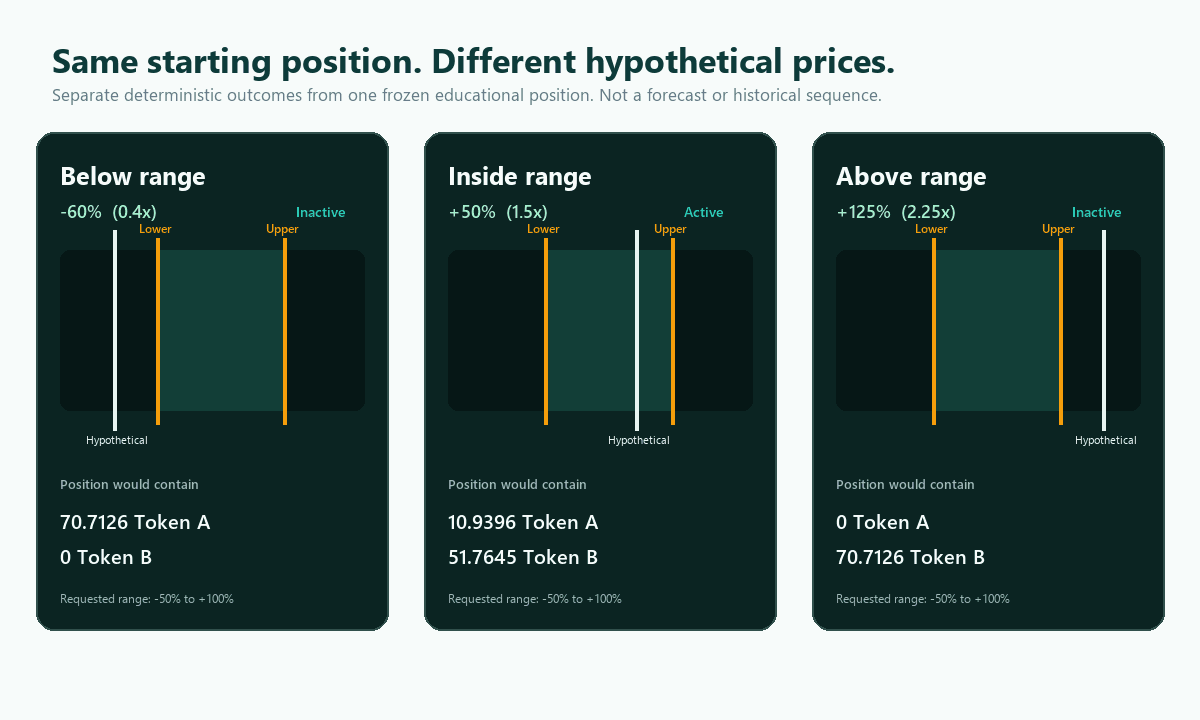
Below, inside, and above your range
| Hypothetical outcome | Price change | Range state | Position would contain |
|---|---|---|---|
| Below range | -60% (0.4x) | Below range | 70.7126 Token A + 0.0000 Token B |
| Inside range | +50% (1.5x) | Inside range | 10.9396 Token A + 51.7645 Token B |
| Above range | +125% (2.25x) | Above range | 0.0000 Token A + 70.7126 Token B |
These panels do not show a historical sequence. They are independent calculations from one frozen educational position. SmoothLP does not claim that any of these prices will occur.
For a deeper explanation of inactive and one-sided positions, read what happens when an LP position goes out of range.
Why can LP value differ from HODL?
HODL retains the original quantities. The LP changes token composition as price moves. Because the two paths can hold different quantities at the hypothetical price, their values can diverge even before fees.
The selected range matters. A narrower or differently positioned range changes how the position's token composition responds to price. See how to choose and compare a concentrated-liquidity range.
Is LP vs HODL the same as impermanent loss?
People commonly use impermanent loss to describe LP underperformance relative to holding the starting assets. SmoothLP prefers LP vs HODL because the label states the comparison directly.
The word "impermanent" does not guarantee that the difference will disappear, and it does not make the difference harmless. The result depends on the hypothetical price, range, token composition, and any fees or costs considered separately.
How SmoothLP's LP Outcome Calculator works
- Choose a network and observed Uniswap V3 pool.
- Choose an LP range.
- Choose how much of either token to use.
- Enter a hypothetical price.
- See what the planned LP would contain at that price.
- Compare LP value with HODL before fees.
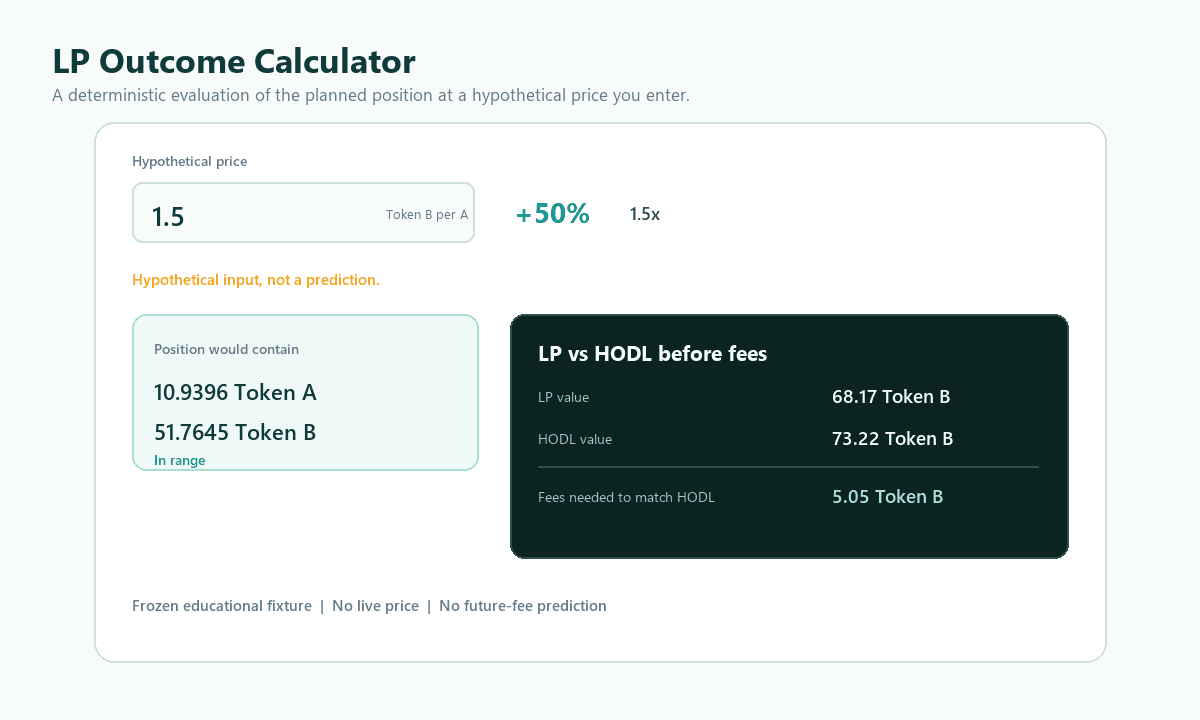
Hypothetical input, not a prediction. Changing this input evaluates the already planned position. It does not fetch a new pool snapshot or predict future market behavior.
Given the captured pool state, planned range, planned position, and hypothetical price, the token composition and LP-versus-HODL calculation are deterministic under the reviewed protocol math. SmoothLP does not know whether or when the hypothetical price will occur.
What "Fees needed to match HODL" means
This result is the amount of fee value the LP would need at that hypothetical price for total LP value to equal HODL value.
It does not predict that those fees will be earned. It is a deterministic break-even amount for the entered hypothetical price.
Why future fees are separate
LP vs HODL before fees intentionally excludes assumptions about future trading activity. This isolates the structural effect of providing concentrated liquidity from assumptions about volume, time, position share, and protocol fees.
The optional Fee Scenario lets you enter assumed average daily pool volume in USD and a number of days. Position-level assumptions appear only when captured protocol-fee evidence supports them. Some pools can show only modeled gross pool swap fees before protocol-fee deductions.
Learn how those assumptions work in the LP fee calculator guide.
What this calculator does not predict
- Future token prices
- Whether the hypothetical price will occur
- Future trading volume or swap direction
- Time in range
- Future fees, gas, slippage, rewards, or taxes
- Which range is best for you
At the captured starting price, LP and HODL begin from effectively the same assets. Tiny raw-unit differences can appear because position funding rounds required amounts up while principal represented by known liquidity rounds down. Those differences are protocol rounding, not a modeled economic loss.
Try it with your own LP range
Plan a range and test hypothetical price outcomes in SmoothLP. You can change the hypothetical price without changing the observed snapshot or making a transaction.
To understand how the starting token amounts are constructed, read how much of each token a liquidity position needs.
Frozen educational fixture
This generic Token A / Token B fixture uses SmoothLP's validated deterministic LP Outcome domain. It is not live market data and does not represent Ethereum, Base, Robinhood Chain, or a current token price.
- Captured price
- 0% (1x)
- Requested range
- -50% to +100% (0.5x to 2x)
- Executable ticks
- -6932 to 6932
- Classification
- frozen-educational-validated-domain
Sources
Canonical article: https://smoothlp.com/learn/lp-vs-hodl-calculator