SmoothLP can show what a range would do at a captured pool snapshot. It cannot tell you where price will go, which range will earn more, or which choice is right for you.
What your Lower and Upper prices mean
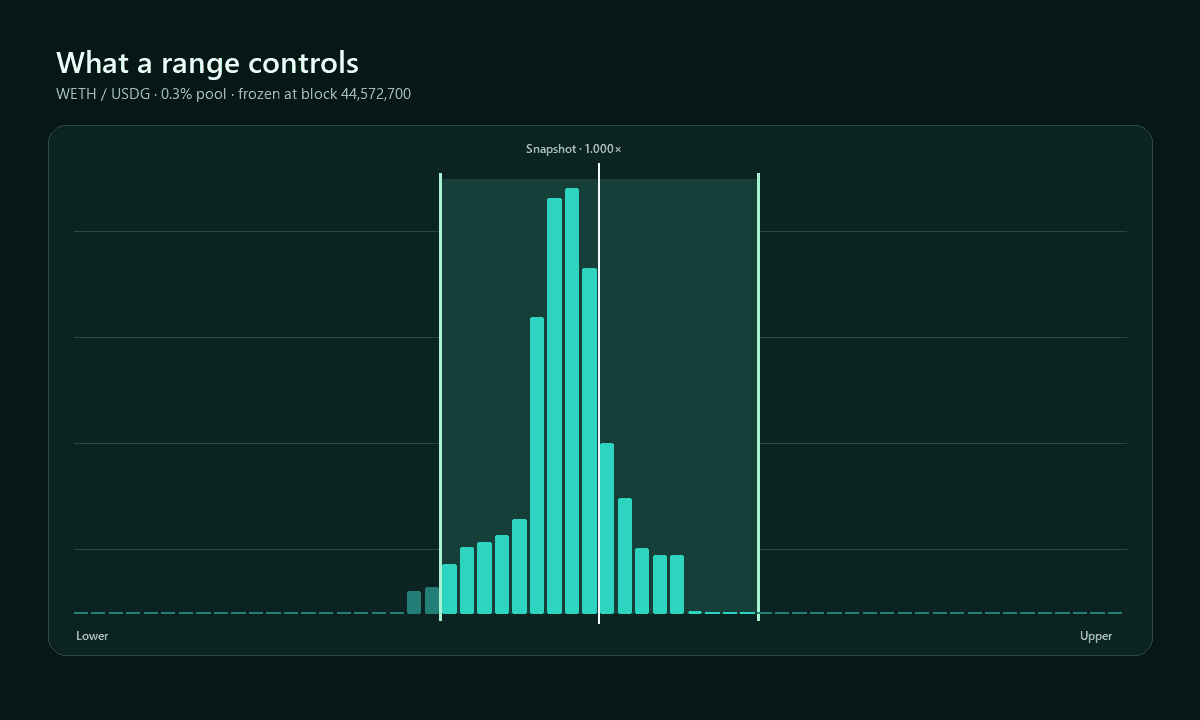
Your Lower and Upper boundaries define the price interval where a concentrated-liquidity position can be active. When the pool price is inside that interval, the position can provide liquidity. When price moves outside it, the position becomes inactive until price returns.
Narrow vs. wide: the simplest explanation
A narrow range concentrates liquidity across less price space. A wide range covers more price movement, so the same position is spread across more of the price curve. That is a tradeoff, not a ranking. “Narrow earns more” and “wide is safer” are both incomplete claims.
A real example: same 1 WETH, three different ranges
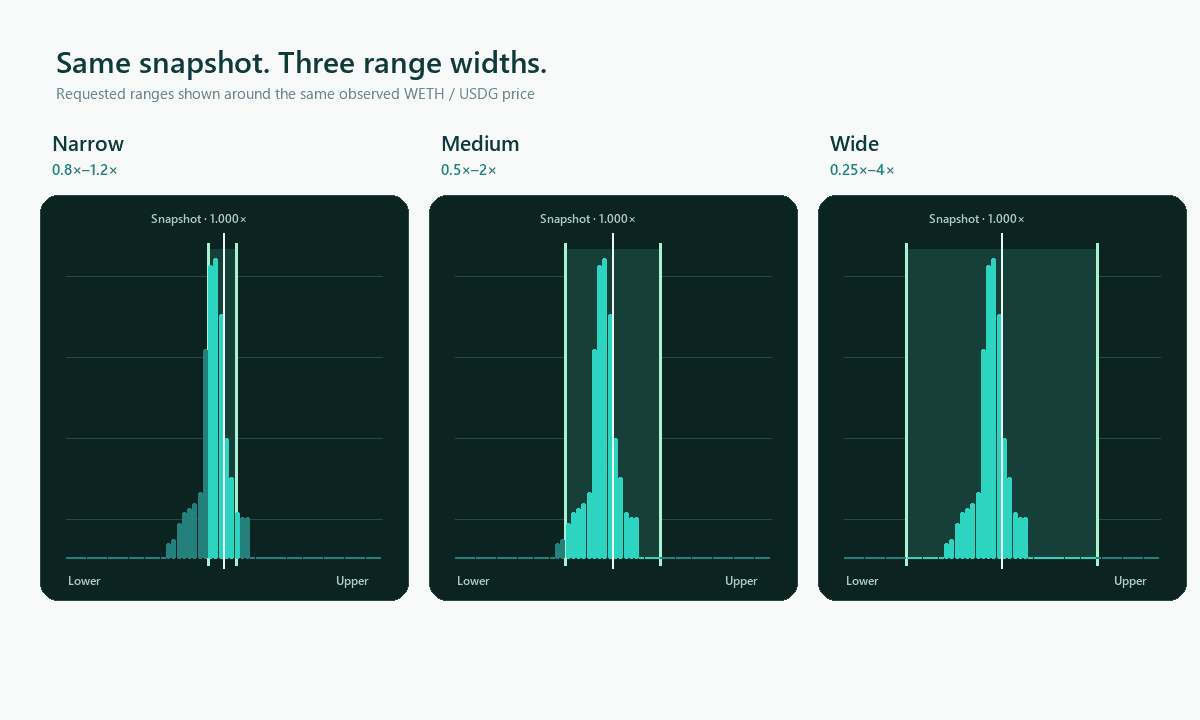
The comparison below changes only the requested range. The pool, 0.3% fee tier, frozen price snapshot, WETH/USDG orientation, and 1 WETH anchor stay fixed.
Percentages show how far each boundary sits from the captured snapshot price. The multiple in parentheses shows the same boundary using SmoothLP's Multiple view.
| Range | Selected range | 1 WETH needs about |
|---|---|---|
| Narrow | -20% to +20% (0.8× to 1.2×) | 2,940.14 USDG |
| Medium | -50% to +100% (0.5× to 2×) | 2,448.54 USDG |
| Wide | -75% to +300% (0.25× to 4×) | 2,433.94 USDG |
SmoothLP uses exact protocol-compatible integer math internally. Tiny raw-unit rounding differences are omitted here for readability.
We did not change the pool, price, or 1 WETH amount. We changed only the LP range, and the amount of USDG required changed.
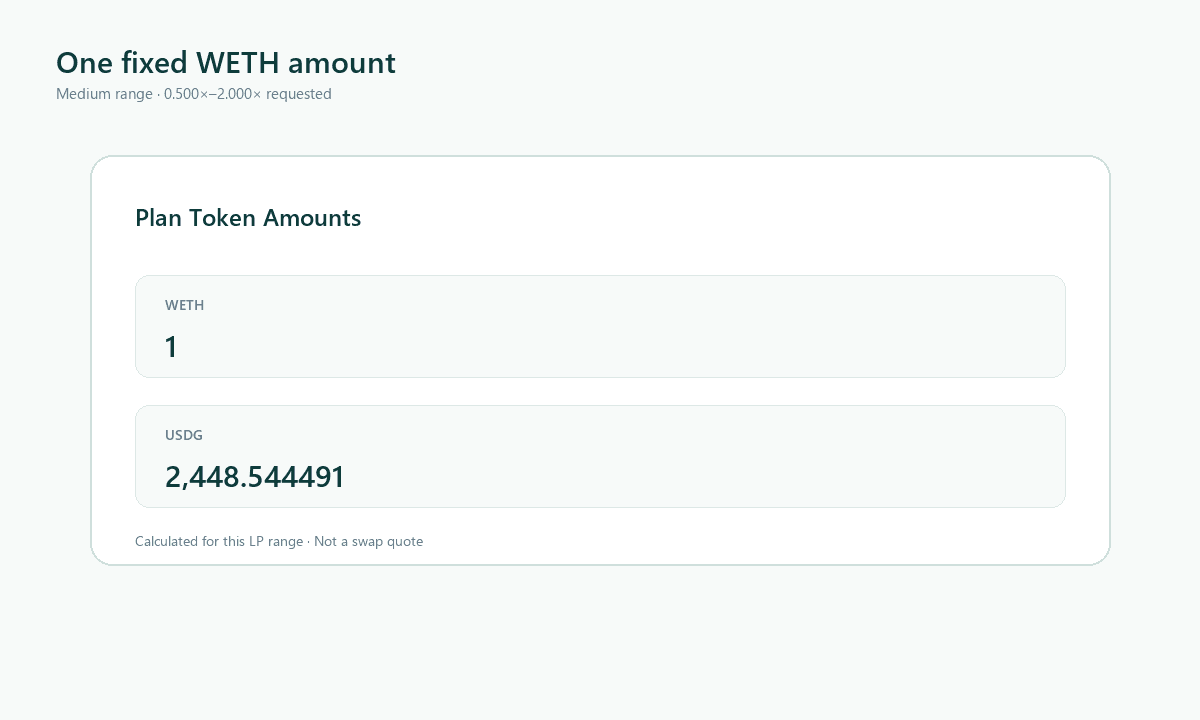
For a focused explanation of this calculation, read how much of each token a liquidity position needs.
Where the current price sits matters
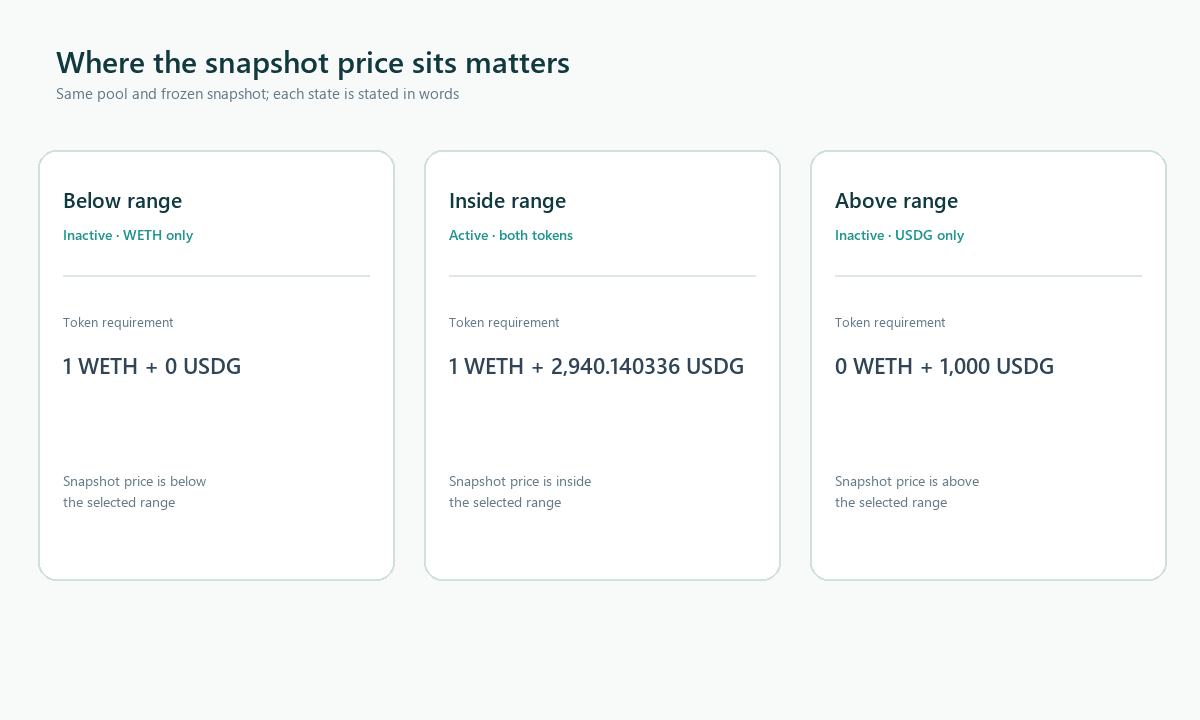
The price does not need to sit exactly in the center of your range. Its location within or outside the interval changes which tokens the position needs at that snapshot.
What happens when price leaves your range
Inside the range, liquidity is active and both tokens can be required. Outside the range, liquidity is inactive and the position becomes one-sided. The position is not automatically closed or liquidated. If price re-enters the range, its liquidity can become active again.
As the pool price moves through your range, the position's mix of the two tokens changes. Once price moves completely beyond the range, the position can become entirely one token.
Read more about what happens when a position goes out of range.
Why the range SmoothLP uses may differ slightly
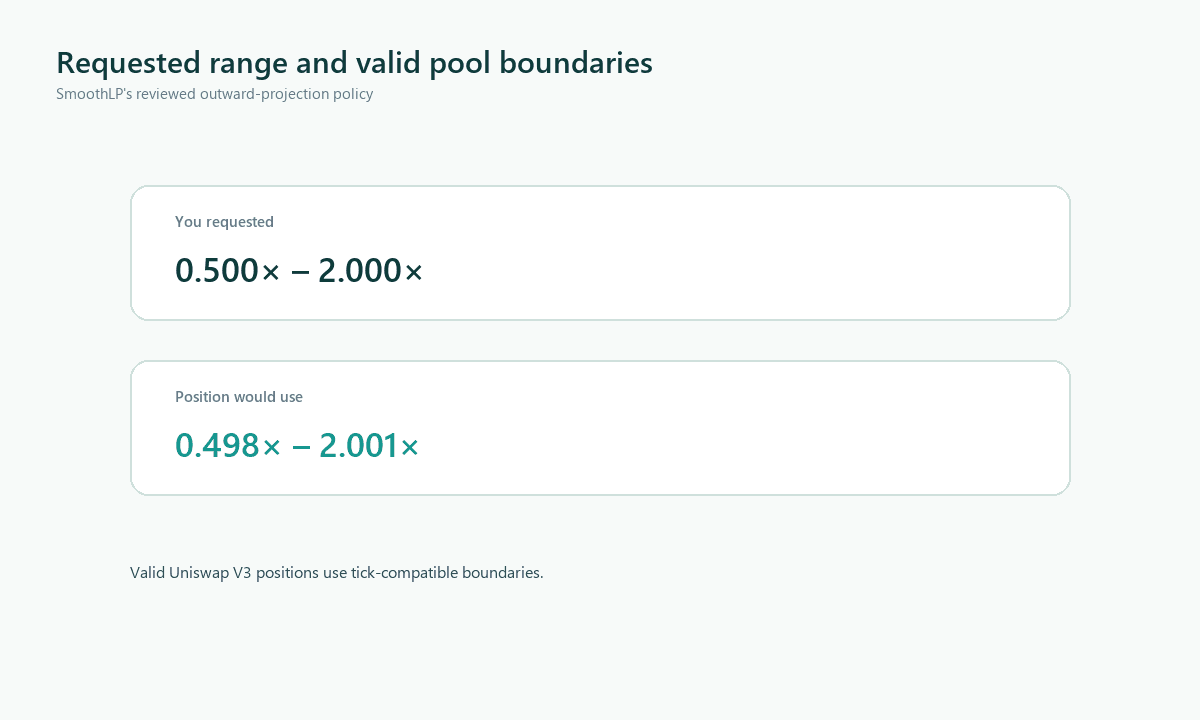
You requested0.500×–2.000×
Position would use0.498×–2.001×
Uniswap V3 positions use specific valid price boundaries called ticks. SmoothLP adjusts outward so the executable range contains the range you requested. This outward projection is SmoothLP's reviewed policy; it does not claim that every Uniswap interface rounds boundaries the same way.
A neutral way to compare ranges
- Pick one pool and fee tier.
- Keep the snapshot fixed.
- Keep the token amount fixed.
- Compare several widths.
- Observe how required token amounts change.
- Move the range above and below price to understand one-sided states.
- Decide whether you understand the tradeoffs.
This process helps you compare consequences. It does not produce an optimal answer.
Common questions
Does a narrower range earn more?
Not necessarily. A narrow range concentrates liquidity while active, but realized fees and results depend on price movement, trading activity, time in range, competition, and other factors SmoothLP does not predict.
Does an LP have to be 50/50?
No. The captured price and range boundaries determine the protocol-compatible token requirements.
What happens if price leaves my range?
The position becomes inactive and one-sided; it is not liquidated. It can become active again if price returns.
Already have a position?
Changing an existing Uniswap V3 position's range requires removing liquidity and creating a new position with different boundaries. This article does not provide transaction instructions.
Frozen example provenance
Robinhood Chain mainnet (chain ID 4663) · WETH/USDG · 0.3% pool · block 44,572,700 · 2026-08-24 04:17:57 UTC · observed price approximately 2,436.07 USDG per WETH.
Technical identifiers
- Pool
0xa9188730fe85be88ad499d7d52b099e800fb0334- Block hash
0x75124441fc98509a3dc67dc6d0e179145d10b0546526d6d9b5fad809d53ec3c2
Sources
- Uniswap Developers: Concentrated Liquidity
- Uniswap Developers: Understanding Liquidity Positions
- Uniswap Support: Add a new V3 position
- Uniswap Support: Out-of-range liquidity
- Uniswap Support: Do I get liquidated outside my range?
- Uniswap Support: Do I need both tokens?
- Uniswap Support: Change a position's range
- Uniswap V3 Core whitepaper
Canonical article: https://smoothlp.com/learn/how-to-choose-concentrated-liquidity-range