SmoothLP lets you enter an amount of either token and calculates the amount of the other token required for that position at the captured pool snapshot.
Does an LP have to be 50/50?
No.
You may hear liquidity pools described as "50/50," but that shorthand can be misleading for concentrated liquidity.
Equal token quantities are not a general requirement. One WETH and one USDG, for example, do not represent equal value at the captured pool price.
Equal token value is not a universal Uniswap V3 construction rule either. The amount of each token a concentrated-liquidity position requires depends on the pool price and the selected range.
Some positions may happen to be approximately balanced by value at a particular price and range. Other in-range positions can require noticeably different values. A position whose complete range is on one side of the price can require only one token.
What determines the two token amounts?
Three inputs are especially important:
- The pool price
- The Lower boundary
- The Upper boundary
Together, these values define where the position would provide liquidity relative to the pool price.
When the price is inside the range, the position generally needs a mixture of both tokens. The exact mixture depends on where the price sits between Lower and Upper. When the complete range is above or below the price, the position is one-sided and requires only one token.
SmoothLP adjusts the requested boundaries slightly outward to valid pool boundaries. It calculates token requirements using this executable range, which is the range a future position would actually use. See how to choose a concentrated-liquidity range for a deeper explanation of requested and executable boundaries.
What does 1× mean?
In this example, 1× is the frozen snapshot price, approximately 2,436.07 USDG per WETH. A boundary at -20% (0.8×) sits below that price, while a boundary at +20% (1.2×) sits above it.
Percentages show how far each boundary sits from the captured snapshot price. The multiple in parentheses shows the same boundary using SmoothLP's Multiple view.
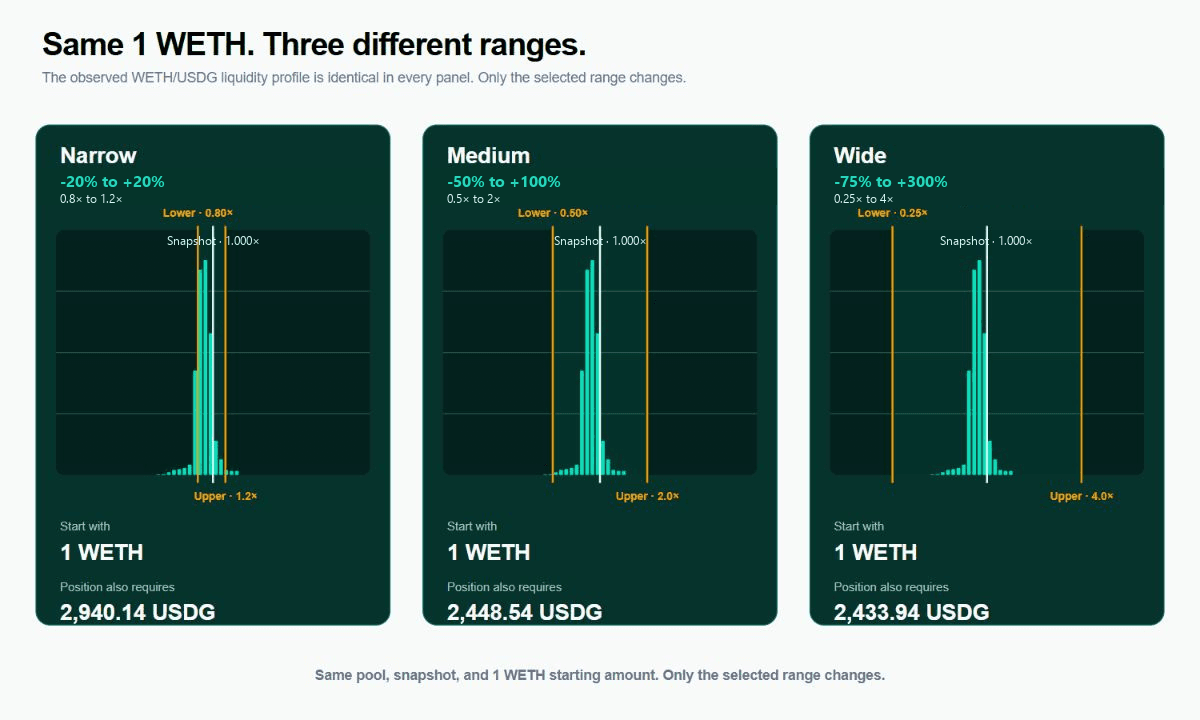
Same 1 WETH, three different ranges
We kept the pool, captured price, and 1 WETH starting amount fixed. Only the selected range changed.
| Range | Selected range | Starting with 1 WETH requires about |
|---|---|---|
| Narrow | -20% to +20% (0.8× to 1.2×) | 2,940.14 USDG |
| Medium | -50% to +100% (0.5× to 2×) | 2,448.54 USDG |
| Wide | -75% to +300% (0.25× to 4×) | 2,433.94 USDG |
The matching USDG amount changes because each range describes a different concentrated-liquidity position.
In the narrow example, 1 WETH supports a position that also requires approximately 2,940.14 USDG. With the medium range, the same WETH starting amount requires approximately 2,448.54 USDG. With the wide range, it requires approximately 2,433.94 USDG.
This comparison covers three reviewed ranges at one frozen snapshot. It does not establish a universal rule that narrowing a range always increases the other-token requirement.
You can start with either token
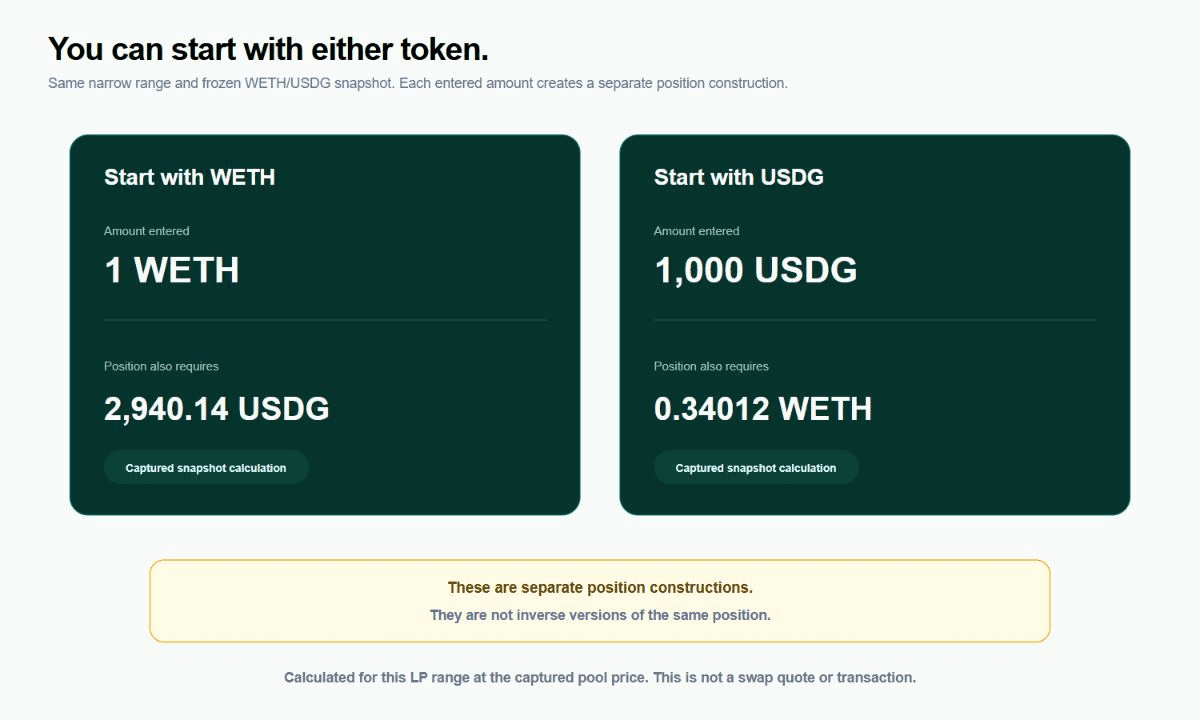
SmoothLP calls the amount you enter the anchor amount. It uses up to that amount to construct the largest position supported by the selected range, then calculates how much of the other token the same position requires.
For the narrow -20% to +20% (0.8× to 1.2×) range:
- Starting with 1 WETH requires approximately 2,940.14 USDG.
- Starting with 1,000 USDG requires approximately 0.34012 WETH.
After you enter an amount, you can edit the other token instead. The token you most recently edit becomes the new starting amount, and SmoothLP recalculates the other side.
If you move Lower or Upper, SmoothLP keeps the amount you entered fixed and recalculates the matching token for the new executable range.
When do you need only one token?
A concentrated-liquidity position can be one-sided when its complete range is above or below the captured snapshot price.
Using the displayed USDG per WETH orientation:
- A range from +20% to +100% (1.2× to 2×) is above the captured snapshot and uses WETH only.
- A range from -20% to +20% (0.8× to 1.2×) contains the captured snapshot and uses WETH plus USDG.
- A range from -50% to -20% (0.5× to 0.8×) is below the captured snapshot and uses USDG only.
This is the clearest reason both tokens are not universally required. The token names depend on the displayed pair orientation.
Read what happens when an LP position goes out of range for the deeper explanation of active, inactive, and one-sided states.

Why does changing the range change the amounts?
A concentrated-liquidity position represents liquidity over a selected price interval. Changing Lower or Upper changes that interval and changes how the captured price sits within it.
The protocol therefore constructs a different position even when the amount you entered remains exactly the same. At one frozen pool price, different ranges can require different mixes of the two tokens.
This is why SmoothLP recalculates the matching token whenever the executable range changes. Zooming the chart or switching between Multiple, Percent, and Price does not change the economic range or the required token amounts.
Requested range and position range
The decimal Lower and Upper values you enter are the requested range. Uniswap V3 positions use discrete tick-compatible boundaries, so SmoothLP adjusts the requested range slightly outward to the valid boundaries the position would use.
The token calculation uses that executable range, not rounded display text.
Have specific balances for both tokens?
Already know how much of both tokens you have available? SmoothLP also has an optional available-balances tool that can preview how those balances fit the selected range.
This is separate from the default linked-token calculation. The default calculation starts with one token amount and determines the other. The available-balances tool treats both amounts as maximum available quantities.
What does this calculation not tell you?
The calculated token requirements do not tell you:
- Whether the position will be profitable
- How much it may earn in fees
- Its future APR or APY
- Where price will move
- How long price will remain in range
- Which range is best
- How much money you should invest
The result belongs to one captured pool snapshot. It is planning information, not a promise about a future transaction.
This is not a swap quote or transaction.
Try it in SmoothLP
Choose a token pair and observed pool, select a range, then enter an amount of either token. SmoothLP calculates the matching token requirement using the captured pool snapshot and the executable range the position would use.
Frozen example provenance
Robinhood Chain mainnet (chain ID 4663) · WETH/USDG · 0.3% pool · block 44,572,700 · 2026-08-24 04:17:57 UTC · captured price approximately 2,436.07 USDG per WETH.
The examples compare different ranges and starting amounts against this one frozen state. They are not a historical price sequence, forecast, wallet balance, or transaction quote.
Technical identifiers
- Pool
0xa9188730fe85be88ad499d7d52b099e800fb0334- Block hash
0x75124441fc98509a3dc67dc6d0e179145d10b0546526d6d9b5fad809d53ec3c2- Evidence timestamp
Sources
Canonical article: https://smoothlp.com/learn/how-much-of-each-token-for-liquidity